Life Saving Actions
Table of Content
Intro
All workers should be aware of the most critical safety hazards found at their worksites that have caused worker loss of life within the industry and actions they can take to minimize their exposure. Personal safety improvement in the onshore Oil and Gas industry can be achieved by implementing and training on a program, typically called LIFE SAVING ACTIONS (LSA), that educates and emphasizes the most critical safety hazards and what steps workers can take to protect themselves and their colleagues from themData Trends
Data information specific to onshore operations is limited, but there are approximately 9000 independent operators in the U.S. onshore exploration and production segment – a number that is vastly larger than the refining and offshore segments. With such a large number of companies, there is a need for consistency and improvement of safety practices across the onshore industry.
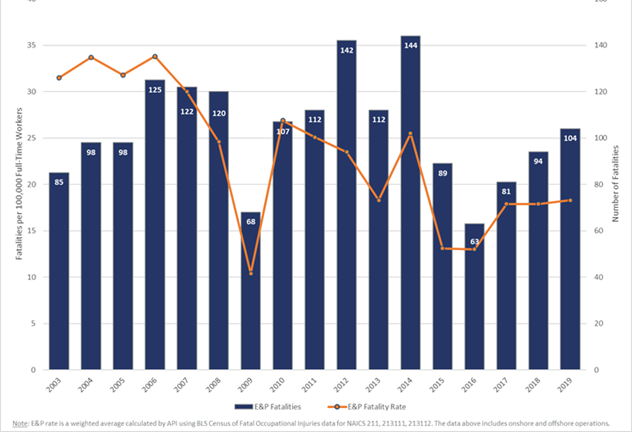
Work-Related Fatalities in U.S E&P Operations
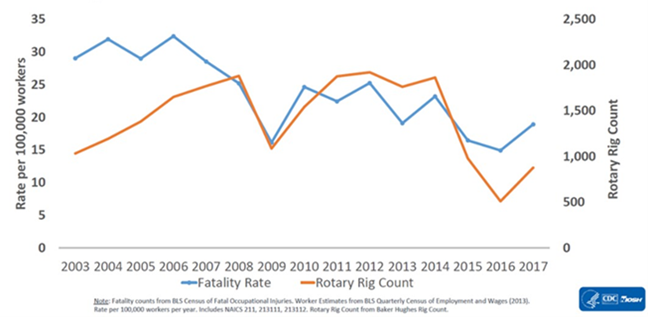
Work-Related Fatality Rate versus Rotary Rig Count
U.S. Onshore Operations Statistics
9000
There are approximately 9000 independent operators in the U.S. onshore exploration and production segment – a number that is vastly larger than the refining and offshore segments.
62%
According to NIOSH, 62% of fatalities in 2017 were to servicing company workers.
376
In 2008-2017, 376 people lost their lives in fatal incidents that might have been prevented by following one of IOGP's Life-Saving Rules.

Join the OSA Safety Program
Through OSA Participant Action 2, companies take steps to implement a life saving actions program so that their workers are aware of the most critical safety hazards found at worksites.
Become a ParticipantIndustry Examples of Life Saving Actions Programs

With the revision of Report 459, IOGP launched a simplified set of Life-Saving Rules to provide workers in the industry with the actions they can take to protect themselves and their colleagues from fatalities.
IOGP Life-Saving Rules
Marathon Oil has implemented our Life Critical Expectations. These expectations clearly define the non-negotiable actions all workers must take in order to perform work safely on its jobsites.
Marathon Oil Life Critical Expectations
The H&P Life Belts set out clear, simple, and consistent expectations focused on activities with the highest risk.
Helmerich & Payne Life Belts
Chevron has implemented within their organization a life saving actions program called Save Your Life Actions.
Chevron Save Your Life Actions & Start Work Checks
Patterson believes the safety and well-being of its employees and the protection of our environment is a cornerstone.
Patterson Cornerstones for Life
The Hess Rules are about putting people first, acting with integrity, performing to a high standard and acting responsibly.
The Hess Rules